
What Can You See on a Madu Ganga Boat Safari? Wildlife, Mangroves and Island Attractions
A Madu Ganga boat safari is mostly an exercise in looking. The things worth seeing are a kingfisher sitting very still above the water, a monitor lizard draped over a root, a tunnel of mangrove branches where the light turns green and a fisherman working his net in the same place his family has worked for years. None of it happens on a timetable. This guide explains what is commonly seen on the river, where in the wetland to look for each thing and how to give yourself the best chance, and it starts with the point that matters most: wild animal sightings are never guaranteed. They depend on the weather, the tide, the time of day and a good deal of luck.
If you are still deciding on trip length, timing or cost, our complete Madu River boat safari guide covers those first. This article picks up from there and looks at what is actually out on the water.
A River That Changes With the Tide
Before the wildlife, it helps to understand why the Madu Ganga behaves the way it does. This is an estuary, a place where fresh water coming down from inland meets the sea. Salt water pushes into the lagoon as the tide rises and drains out as it falls, so the water you glide over in the morning is not quite the same mixture as the water you see in the afternoon. That slow exchange feeds the whole system. More than 110 bird species and over 75 kinds of fish have been recorded here over the years, along with dozens of reptiles, and the larger listings for the protected area count roughly 250 vertebrate species and about 300 plants. Those figures are for the whole wetland over many years of observation, so please read them as a measure of how rich the place is, not as a list you are going to complete in a single morning.
What this means for a visitor is that the river never looks the same twice. A channel that was full of feeding birds on Monday can be quiet on Tuesday, and a stretch of bank with nothing on it at nine can have a lizard sunning itself by ten. Our riders know the usual spots, but they say the same thing we do: you can improve your chances, you cannot arrange the outcome.
Mangrove Tunnels
The mangroves are the main reason people book a Madu Ganga boat safari, and they also hold everything else together. Three species are commonly named here, red mangrove types such as Rhizophora mucronata, a grey-barked tree called Avicennia marina, and Bruguiera gymnorrhiza. You do not need to tell them apart to enjoy them, but you will notice the root systems straight away. In the shallows the roots arch out of the water in tangled loops, and in some places they form dense walls that look as if they were woven. Those roots are what slow the water, trap silt and give small fish, crabs and young animals somewhere to hide, which in turn is why birds and larger predators gather around them.
The tunnels themselves are channels narrow enough that the branches meet above the boat. When the rider eases into one, the air cools by a degree or two, the engine drops to almost nothing and the light changes to a soft green. This is the part of the trip we would never skip. It is also the best time to stop talking for a minute. If you listen, you will often hear small splashes, wings against leaves or a bird call you missed while the boat was moving. Our Experiences page describes the tunnels and the other stops on a typical route.
Kingfishers and Other Birds
Birds are the most reliable sightings on the Madu Ganga, and that is why many of our regular guests are birdwatchers and photographers. Kingfishers are the ones people ask about first. They sit on low branches or on the posts that stick out of the shallows, watch the water with enormous patience and then drop in a flash. The trick is to scan the lowest branches near the surface, because that is where they like to perch. Herons and egrets stand at the edge of the reeds and the roots, cormorants dry their wings on stakes after diving, and in the open sky above the lagoon you may see raptors circling. Purple herons and little cormorants are among the species recorded here, and visitors also report sea eagles and kites over the water.
Early morning is the best time. The water is flat, the birds are active and the light is soft enough for photographs. A drifting boat startles birds far less than a moving one, so when you spot something, ask your rider to switch the engine off. Most are glad to do it. If birds are your main reason for coming, the three-hour Sunrise Boat Safari is the most likely to deliver, because it puts you on the water while the lagoon is still waking up. Bring binoculars if you have them, or a camera with a zoom lens.
Monitor Lizards
If a bird is a maybe, a water monitor is close to a probable. These are large lizards, often well over a metre long, and they are one of the most frequent big animals along the river. You will typically see them lying on roots or low branches, sunning themselves with their legs spread, or swimming with only the head above water. They look prehistoric and are quite shy. When a boat gets too close they slide into the water with a loud splash, so the best sightings come when the rider approaches slowly and cuts the engine early.
Children tend to love them, and adults often do too. They are also a useful reminder of how the river works, since a monitor on a root usually means there is food nearby. Keep your hands inside the boat, stay seated and let the lizard decide how long it wants to stay.
Crocodiles
Crocodiles do live in the Madu Ganga wetland, and some sources name both mugger and estuarine crocodiles among the reptiles found here. But sightings are occasional. On some days a guest spots one on a bank or in the water, and on many days nobody does. They are shy animals and tend to stay out of the way of boats. Our riders keep a safe distance, do not go looking for them and would never encourage guests to approach one. It is worth being clear with yourself before you book: if a crocodile is the only thing you want from the trip, the river may not give you that.
The better way to think about it is as a bonus. If one turns up, the whole boat will talk about it for the rest of the morning. If one does not, you will still have seen the mangroves, the birds and the island life, which is the real trip. Be wary of any operator who promises you a crocodile, and be careful of any stop where a baby crocodile is handed around for photographs. A wild animal handled by tourists is not a good sign, and we would rather you left with honest memories.
Flying Foxes and Other Wildlife
Flying foxes are large fruit bats, and in many parts of Sri Lanka they roost in tall trees by day and fly out at dusk to feed. They are not something we can point to on every route, and they are not a regular feature of every trip, but guests who go out in the late afternoon sometimes see them hanging in the canopy or crossing the sky as the light fades. If bats are your priority, mention it to your rider before you leave, and consider our Sunset Boat Safari, because dusk gives you the best chance of seeing them in flight. As with everything else here, we can tell you where to look, not promise a result.
Other animals show up less predictably. Monkeys and giant squirrels move through the trees near the temple and along the banks, water snakes slip through the shallows, and wild boar are sometimes mentioned by visitors who go early. Smaller life is easy to overlook: crabs working among the roots, butterflies along the edges and the fish that flicker beneath the boat. The wetland records dozens of reptile species, many of them hard to find unless you know exactly where to look, so the best approach is to keep your eyes open for movement and enjoy whatever shows up.
Temple Islands and Island Life
Not everything worth seeing on a Madu Ganga boat safari has fur or feathers. Some of the islands carry a temple, a shrine or a few houses with gardens, and a short stop on them tells you a lot about how life works on the water. The best known is Kothduwa, a Buddhist temple on an island you can only reach by boat. The temple is associated with a legend that a sacred relic was once hidden on the island, and visitors often notice the old Bodhi tree and the novice monks going about their routine. Dress modestly, take your shoes off where asked and keep your voice low. A scarf or sarong over your shoulders and knees is enough.
Elsewhere, Satha Paha is the smallest of the islands, with a shrine dedicated to the god Kataragama, and the larger Ma Doowa island has a temple of its own and a footbridge that links it to Balapitiya. Another stop is the cinnamon island, where families peel and roll the bark by hand, a good example of the small-scale industries that keep people living on the lagoon. Whichever stops are on your route, treat them as visits to someone’s home. If the cinnamon island interests you, read how Ceylon cinnamon is made on Cinnamon Island before you go. The island stops differ by package, so check what each includes on our packages page before you book.
Local Fishing Activity
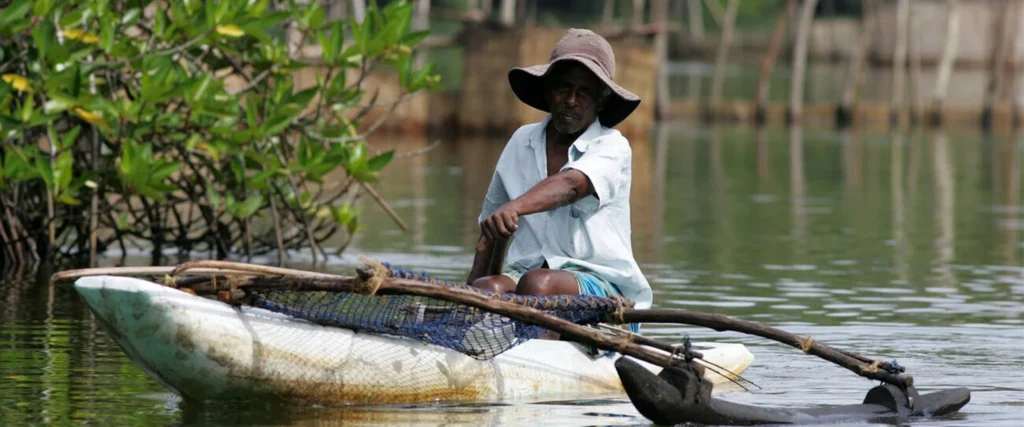
Fishing is part of the daily rhythm on the Madu Ganga, and watching it is a quiet pleasure. Depending on the hour, you might see people in small boats lifting nets, standing waist-deep in the shallows or working the banks with a line. Upstream, you may also notice tall bamboo structures set in the water that were traditionally used for prawn fishing. That livelihood has declined in recent years, and what remains is smaller than it once was. A floating fish farm near one of the islands breeds red tilapia in cages, and some visitors dip their feet in for the fish to nibble. That stop is optional, and anyone with cuts or skin problems on their feet should skip it.
There are a few courtesies worth keeping in mind. Keep a respectful distance from people working, ask before taking close-up photographs of faces and avoid passing between a fisherman and his net. Fishing is also the reason many birds gather around the stakes and posts, so what you see on the water and what you see in the air are often linked. If you would like to try fishing yourself, we offer a separate fishing trip by private boat.
How to Improve Your Chances
None of this guarantees a sighting, but a few habits make a real difference. Go early or late, when the light is low and animals are most active. Sit still and keep your voice down once you are in the narrow channels, because sound carries over water far more than people expect. Let your rider lead, since he knows where birds tend to perch on any given day and will slow down if he sees something. Use binoculars if you have them, look low at the roots and the waterline as well as up into the trees and be patient. Some of the best moments on this river come when the boat has stopped and everyone is simply waiting.
It also helps to check the weather. Heavy rain can cancel a trip altogether. Our guide to the best time to visit the Madu River explains how the day and the season change what you see. If the weather is uncertain, ask us before you travel and we will tell you honestly how the river looks.
Bringing Children
Families do very well on the Madu Ganga, mainly because there is always something small to find. A game works well: give each child a short list, such as a bird on a branch, a lizard, a house on stilts and a fisherman with a net, and let them tick items off as you go. It keeps younger children looking, and it takes the pressure off hoping that something big will appear. Choose a morning or late-afternoon departure when the heat is gentler, and keep a hat and water within reach. Life jackets are provided in sizes for children, and you can read how we look after families on our Safety & Comfort page.
Book Your Madu Ganga Boat Safari
If you would like to see the river for yourself, pick a length and a time of day that suits what you want from the trip, then choose a package from our packages page. If you are not sure which suits birdwatching, photography or a family outing, send us a message and we will recommend one.